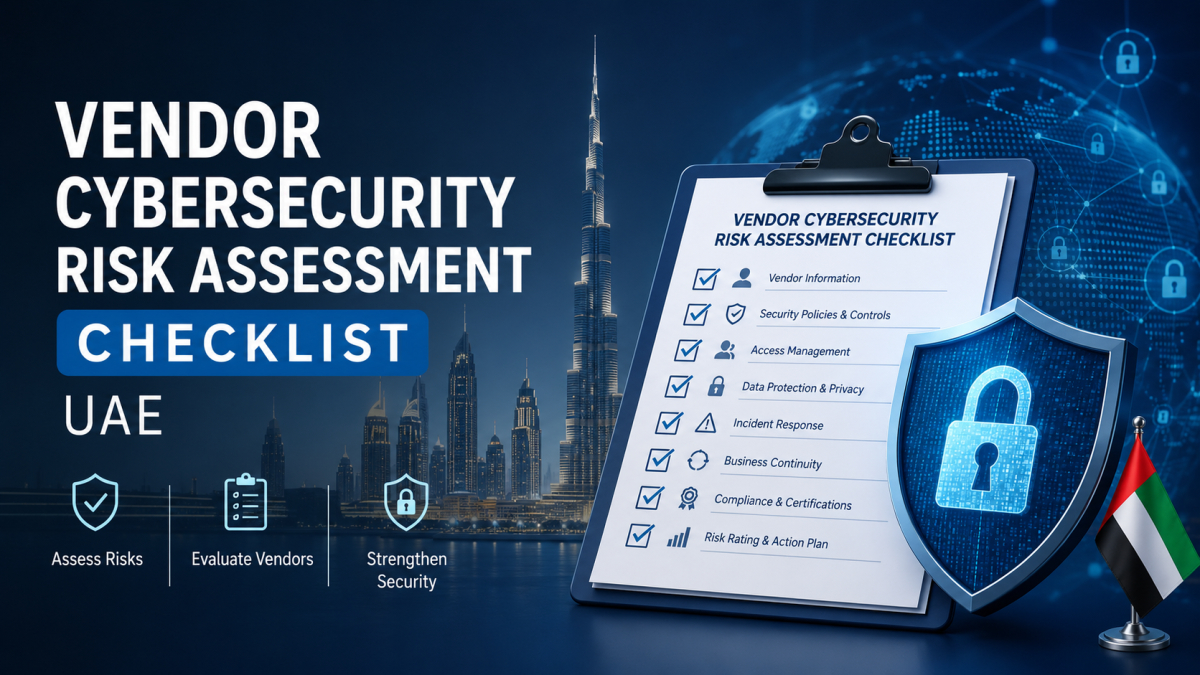
Third Party Vendor Cybersecurity Risk Assessment Checklist for UAE Small Businesses
A 22-person accounting firm in DIFC used a small local IT support company for server management. That IT company also supported 30 other businesses. When the IT provider was breached through an unpatched RMM (Remote Monitoring and Management) tool, attackers gained admin access to all 31 client networks — including the accounting firm with access to financial data of 200+ companies. Total impact: AED 4.5 million across all affected businesses. The accounting firm’s clients held them responsible. The IT provider had no cyber insurance and folded within 3 months.
Your security is only as strong as your weakest vendor. UAE small businesses typically have 10-50 third-party vendors with some level of access to their data or systems — IT providers, cloud services, payroll processors, CRM vendors, accounting software, marketing platforms. Each one is a potential attack vector. NESA and UAE PDPL require vendor risk management. This guide provides the practical framework, checklists, and templates to assess and manage vendor cybersecurity risk.
Table of Contents
- Why Vendor Risk Matters
- Vendor Inventory
- Risk Tiering
- Assessment Checklist
- Risk Scoring Method
- Contract Security Clauses
- Ongoing Monitoring
- UAE Regulatory Requirements
- Vendor Incident Management
- Tools and Templates
- FAQ
- Conclusion
Why Vendor Risk Matters
| Statistic | Data |
|---|---|
| % of data breaches involving third parties | 62% (2023 Verizon DBIR) |
| Average cost of third-party breach | AED 1.2 million (global average for SMEs) |
| Number of vendors for typical UAE SME | 15-40 with data access; 5-15 with system access |
| % of SMEs that assess vendor security | Only 23% (UAE estimate) |
| Supply chain attack growth (2022-2023) | +78% year-over-year globally |
| Average time to detect third-party breach | 235 days (vs 197 days for internal breaches) |
Step 1: Vendor Inventory
| Vendor Category | Examples | Typical Data/Access |
|---|---|---|
| IT infrastructure | Managed IT provider, cloud hosting, domain registrar | Admin access to servers, network, email |
| Software / SaaS | CRM, ERP, accounting software, project management | Business data, customer records, financial data |
| Communication | Email (Microsoft 365, Google), phone system, messaging | All communications, contacts, attachments |
| Human resources | Payroll, HR system, recruitment platform | Employee PII, salaries, Emirates ID, bank details |
| Financial | Payment processor, banking APIs, accounting firm | Financial records, payment data, bank credentials |
| Marketing | Marketing automation, analytics, social media tools | Customer data, website analytics, contact lists |
| Legal / compliance | Legal firm, compliance platform, audit firm | Confidential business information, contracts |
| Physical services | Cleaning, security guards, building management | Physical access to offices; may access unlocked devices |
Action: Create a spreadsheet listing ALL vendors. For each: vendor name, service provided, data they access, system access level, contract start/end date, last assessed date. This becomes your vendor register — a living document you update as vendors change.
Step 2: Risk Tiering
| Tier | Criteria | Assessment Level | Frequency | Examples |
|---|---|---|---|---|
| Tier 1 — Critical | Admin access to systems OR processes sensitive data (PII, financial) OR business-critical service (if down, business stops) | Full assessment (50-100 questions) | Annual + continuous monitoring | IT provider, cloud hosting, ERP, payroll, payment processor |
| Tier 2 — High | Limited data access OR important but not critical service OR customer-facing | Standard assessment (20-40 questions) | Annual | CRM, marketing platform, HR system, legal firm |
| Tier 3 — Medium | Minimal data access OR internal-only service OR easily replaceable | Light assessment (10-15 questions) | Every 2 years | Project management tool, office supplies, design tools |
| Tier 4 — Low | No data access AND no system access AND non-critical | Basic due diligence only | At onboarding | Cleaning service, courier, catering |
Step 3: Assessment Checklist
Tier 1 — Critical Vendor Assessment (Full)
| # | Category | Question | Expected Answer |
|---|---|---|---|
| 1 | Certifications | Do you hold ISO 27001, SOC 2, or equivalent certification? | Yes — provide current certificate |
| 2 | Certifications | When was your last external penetration test? Share executive summary? | Within 12 months; willing to share summary |
| 3 | Access control | Do all employees use MFA to access client data/systems? | Yes — mandatory MFA for all |
| 4 | Access control | How do you manage privileged access (admin accounts)? | PAM solution; named accounts; regular review |
| 5 | Access control | Do you have an access offboarding process when employees leave? | Yes — same-day deactivation |
| 6 | Data protection | Is our data encrypted at rest and in transit? | Yes — AES-256 at rest; TLS 1.2+ in transit |
| 7 | Data protection | Where is our data stored? Which country/region? | UAE or approved jurisdiction per PDPL |
| 8 | Data protection | Do you have a data retention and deletion policy? | Yes — documented policy; deletion on request |
| 9 | Incident response | Do you have a documented incident response plan? | Yes — tested annually |
| 10 | Incident response | What is your breach notification timeline to affected clients? | Within 24-72 hours |
| 11 | Backup & continuity | What is your backup frequency and retention? | Daily; 30+ days retention; tested quarterly |
| 12 | Backup & continuity | What is your disaster recovery RTO/RPO? | RTO: 4-24 hours; RPO: 1-24 hours |
| 13 | Endpoint security | What endpoint protection do you use? Is it centrally managed? | EDR (named product); centrally managed |
| 14 | Vulnerability mgmt | How frequently do you patch systems and applications? | Critical: 72 hours; regular: monthly |
| 15 | Insurance | Do you carry cyber liability insurance? What is the coverage? | Yes — AED 1M+ coverage |
| 16 | Subcontractors | Do you use subcontractors who may access our data? | Disclosed; same security requirements applied |
| 17 | Compliance | Are you compliant with UAE PDPL for personal data processing? | Yes — documented compliance measures |
| 18 | Staff security | Do employees receive security awareness training? | Yes — annual minimum; documented |
| 19 | Staff security | Do you conduct background checks on employees with client access? | Yes — pre-employment screening |
| 20 | Logging | Do you log access to client data? How long are logs retained? | Yes — minimum 12 months retention |
Risk Scoring Methodology
| Score | Rating | Meaning | Action |
|---|---|---|---|
| 85-100% | Low risk | Strong security posture; meets or exceeds expectations | Approved; annual reassessment |
| 70-84% | Moderate risk | Adequate with some gaps; improvement needed | Approved with conditions; remediation plan; 6-month follow-up |
| 50-69% | High risk | Significant gaps; elevated breach risk | Conditional approval; mandatory remediation; quarterly review |
| Below 50% | Critical risk | Serious security deficiencies; unacceptable risk | Reject OR restrict access until remediation; consider alternative vendor |
Contract Security Clauses
| Clause | What to Include | Why |
|---|---|---|
| Data Processing Agreement (DPA) | PDPL-compliant DPA defining data categories, processing purpose, retention, deletion, subprocessors | Legal requirement under UAE PDPL |
| Security standards | Minimum security requirements (encryption, MFA, EDR, patching frequency) | Set baseline; contractual obligation |
| Breach notification | Vendor must notify you within 24-48 hours of suspected breach affecting your data | Faster response; regulatory compliance |
| Audit rights | Right to audit vendor’s security controls or request third-party audit report | Verify compliance; ongoing assurance |
| Data location | Specify approved data storage locations (UAE, named countries) | PDPL cross-border transfer compliance |
| Subcontractor approval | Prior written approval required for subcontractors accessing your data | Control fourth-party risk |
| Data return and deletion | Upon termination: return all data + certify deletion within 30 days | Prevent data retention after relationship ends |
| Liability and indemnification | Vendor liable for breaches caused by their negligence; indemnifies your losses | Financial protection |
| Insurance requirement | Vendor must maintain cyber liability insurance (minimum AED 1M for Tier 1) | Ensures financial capacity to cover breach costs |
| Termination rights | Right to terminate for material security breach or failure to remediate findings | Exit strategy for non-compliant vendors |
Ongoing Monitoring
| Activity | Tier 1 | Tier 2 | Tier 3 |
|---|---|---|---|
| Full reassessment | Annual | Annual | Every 2 years |
| Certification verification | Annual (check expiry) | Annual | At assessment |
| Security rating monitoring | Continuous (SecurityScorecard, BitSight) | Quarterly check | N/A |
| Breach news monitoring | Continuous (Google Alerts, threatintel feeds) | Monthly check | N/A |
| Access review | Quarterly — review what access vendor still needs | Annual | N/A |
| Contract review | Annual — check SLA compliance, terms | At renewal | At renewal |
UAE Regulatory Requirements
| Regulation | Vendor Requirement | Your Obligation |
|---|---|---|
| UAE PDPL (Art. 23) | Data processors must implement appropriate security measures | Written DPA; verify processor security; remain liable for data |
| UAE PDPL (Art. 22) | Cross-border transfers require adequate protection | Verify data location; implement transfer mechanisms for non-UAE storage |
| NESA (T8) | Third-party security management | Vendor risk assessment; security requirements in contracts; monitoring |
| CBUAE | Domain 3 (Protect) — Third-party management | Due diligence; ongoing monitoring; contractual security obligations |
| ISO 27001 (A.5.19-5.22) | Supplier relationships; supplier service delivery management | Supplier security policy; assessment; monitoring; change management |
Vendor Incident Management
| Scenario | Your Response | Timeline |
|---|---|---|
| Vendor notifies you of a breach | Activate your incident response plan; assess impact on your data; communicate with stakeholders | Within 4 hours of notification |
| You discover vendor breach via news/monitoring | Contact vendor immediately; request formal incident report; assess your exposure | Immediately upon discovery |
| Vendor breach affects your customer data | Notify customers per PDPL; notify regulatory authority; document everything | Within 72 hours |
| Vendor refuses to cooperate after breach | Invoke audit rights; engage legal counsel; consider termination; report to authorities | Within 48 hours |
| Vendor fails security reassessment | Issue remediation requirements with deadline; restrict access if critical; plan migration if needed | 30-90 day remediation window |
Tools and Templates
| Tool | Purpose | Cost | Best For |
|---|---|---|---|
| Spreadsheet (Excel/Sheets) | Vendor register + risk assessment tracker | Free | Under 20 vendors; starting out |
| Vanta / Drata | Automated vendor risk management; questionnaire distribution | AED 3,000-8,000/month | 20+ vendors; compliance-driven businesses |
| SecurityScorecard / BitSight | External security rating monitoring of vendors | AED 5,000-15,000/year | Continuous monitoring of critical vendors |
| OneTrust Third Party | Full vendor risk management platform | AED 8,000-20,000/year | Larger SMEs with regulatory requirements |
| Google Forms + Sheets | Send questionnaires; collect responses; track in spreadsheet | Free | Simple, effective for small businesses |
| SIG Lite questionnaire | Standardized vendor security questionnaire (Shared Assessments) | Free download | Industry-standard assessment template |
FAQ: Vendor Risk Assessment for UAE SMEs
We only have 15 vendors. Do we really need a formal process?
Yes — even 15 vendors create significant risk if unmanaged. The SolarWinds attack affected organizations through a single trusted vendor. Your IT provider alone has admin access to your entire infrastructure. Your payroll provider has employee bank details and Emirates IDs. Your cloud hosting provider stores all your business data. A formal process doesn’t mean expensive software — a spreadsheet vendor register, a simple questionnaire, and annual review is sufficient for 15 vendors. Total effort: 2-3 days to set up; 1 day per year to maintain. Cost: AED 0 using free templates. The process: (1) List all vendors in a spreadsheet. (2) Tier them by risk. (3) Send Tier 1 vendors a 20-question security questionnaire. (4) Review responses. (5) Add security clauses to contracts at renewal. This takes one person 2-3 days and costs nothing but provides meaningful risk reduction.
What if a vendor refuses to complete our security questionnaire?
This happens — and it tells you something. Options: (1) For large vendors (Microsoft, Google, Salesforce): they won’t do individual questionnaires. Instead: review their SOC 2 reports (available on request or in their trust center), ISO 27001 certificates, and published security documentation. This is equivalent. (2) For small/medium vendors: reluctance to answer basic security questions is a red flag. Escalate: explain regulatory requirement (PDPL), offer to simplify the questionnaire, propose a call instead of written response. (3) If they still refuse: consider alternative vendors. At minimum: document the refusal, assess risk based on available information, implement compensating controls (limit their access, add monitoring). (4) Contract leverage: at renewal, make questionnaire completion a contract requirement. Many vendors are increasingly prepared for security questionnaires as UAE compliance requirements grow.
How do we assess the security of large cloud providers like AWS, Microsoft, Google?
Large cloud providers have extensive security programs that exceed most SME requirements. Don’t send them your questionnaire — instead: (1) Review their compliance certifications: SOC 2 Type II, ISO 27001, CSA STAR — published on their trust centers. (2) Check UAE-specific compliance: AWS UAE region (launched 2022), Azure UAE regions (Dubai, Abu Dhabi), Google Cloud Doha (nearest). (3) Review their Shared Responsibility Model — understand what they secure vs what YOU secure. (4) Configure their security features properly — the cloud provider’s security is strong, but YOUR configurations may not be. Most cloud breaches are customer misconfiguration, not provider failure. (5) Focus your assessment effort on: your configuration, your access controls, your data encryption settings, your backup strategy. (6) For SaaS vendors (Salesforce, HubSpot, Slack): request SOC 2 Type II report; review security documentation; verify data location.
What’s the minimum vendor risk management for a 20-person company?
Minimum viable vendor risk management: (1) Vendor register (spreadsheet): list all vendors, what data they access, contact info, contract dates. Time: 2 hours. (2) Risk tiering: categorize each vendor as Tier 1-4 based on data access and criticality. Time: 1 hour. (3) Tier 1 assessment: send 15-20 question security questionnaire to your 3-5 critical vendors (IT provider, cloud hosting, payroll, accounting software). Time: 2 hours to send; 1-2 weeks to collect responses. (4) Contract review: ensure critical vendor contracts include DPA, breach notification, and security requirements. Time: 4-8 hours (or have your lawyer review). (5) Annual review: repeat assessment for Tier 1; check Tier 2 certifications. Time: 1 day/year. Total setup: 2-3 days. Annual maintenance: 1-2 days. Cost: AED 0 (templates and spreadsheets). This covers PDPL and NESA basic requirements for third-party management.
Our IT provider has admin access to everything. How do we manage this risk?
IT providers are typically your highest-risk vendor — they have the keys to your kingdom. Management approach: (1) Assessment: conduct full Tier 1 assessment. Verify they have: MFA on all admin accounts accessing your systems, named individual accounts (not shared admin), current cyber insurance, incident response plan, background checks on staff. (2) Technical controls: implement MFA on their admin access (even if they resist — this is non-negotiable). Use time-limited/just-in-time admin access where possible. Enable full audit logging of their activities. Segment their access — do they need access to everything? (3) Contractual: signed DPA, SLA with security requirements, breach notification within 24 hours, termination rights for security failures, cyber insurance requirement. (4) Monitoring: review their access logs monthly. Conduct annual assessment. Set up alerts for admin account activities. (5) Diversification: avoid single points of dependency. Ensure you have admin credentials independently. Have a documented exit plan if you need to change providers.
About the Author
Ahmad Al-Muhairi, CRISC, CISA is a risk management specialist with 12 years of experience in third-party security assessment across UAE organizations. Previously managing vendor risk for a major UAE bank’s technology portfolio of 200+ vendors, he now helps SMEs implement practical, proportionate vendor risk management programs that satisfy regulatory requirements without creating unnecessary bureaucracy.
Conclusion
Third-party vendor risk is the most underestimated security risk for UAE small businesses. With 62% of data breaches involving third parties, your vendor security IS your security. The solution is proportionate: start with a vendor inventory (spreadsheet), tier by risk, assess critical vendors with a 15-20 question checklist, and add security clauses to contracts. Total cost: AED 0 and 2-3 days of work. This satisfies UAE PDPL data processor requirements, NESA third-party management controls, and ISO 27001 supplier security requirements. Focus on your top 3-5 vendors first — your IT provider, cloud hosting, payroll, and accounting software. These handle your most sensitive data and should meet minimum standards: MFA, encryption, breach notification, cyber insurance. Review annually. The businesses that manage vendor risk prevent the breaches that businesses ignoring it suffer.
Start Assessing
Free vendor risk assessment template for UAE small businesses. Includes: vendor register spreadsheet, tiering matrix, security questionnaire (20 questions), and contract security clause templates — customized for UAE PDPL and NESA requirements.