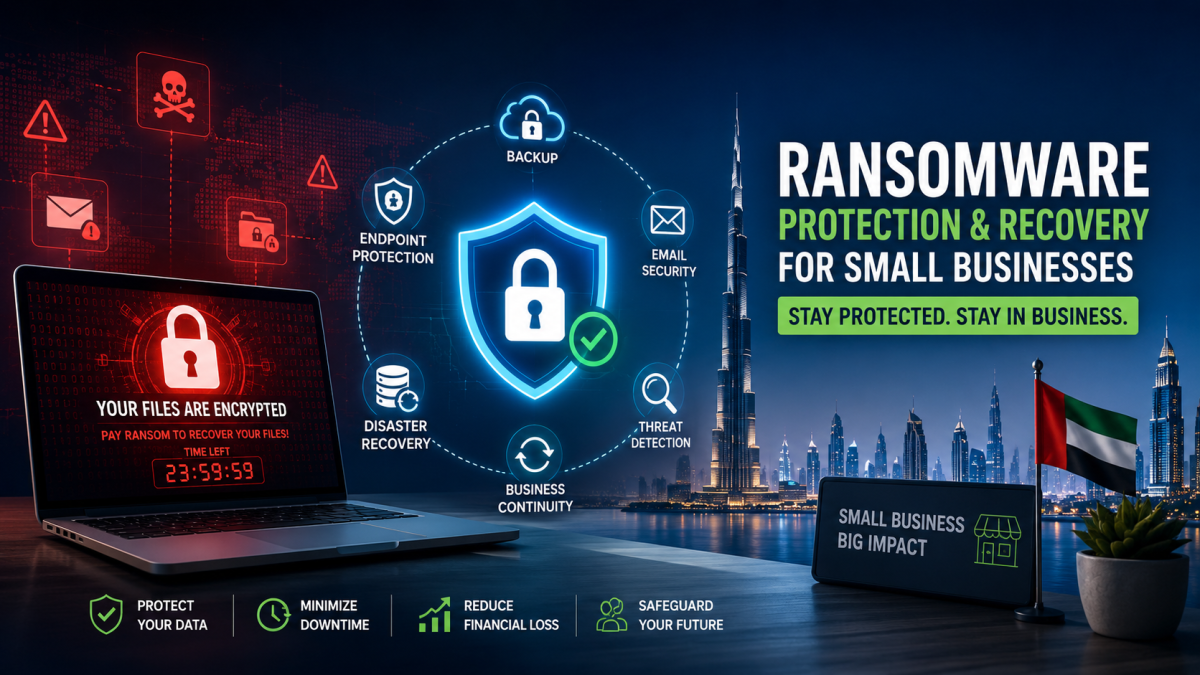
Ransomware Protection and Recovery Solutions for Small Businesses in UAE: Prevention Strategies
Monday morning, 7:30 AM. A 35-person trading company in Deira opens their computers and sees a red screen: “Your files have been encrypted. Pay 3 BTC (approximately AED 400,000) within 72 hours or your data is permanently lost.” Their file server, accounting system, customer database, and 8 years of business documents — all encrypted. Backups? They had a USB hard drive backup — plugged into the server — also encrypted. They paid AED 280,000 after negotiation. Total cost including downtime and recovery: AED 650,000. This company is one of hundreds of UAE small businesses hit by ransomware every year.
Ransomware is the #1 cybersecurity threat to UAE small businesses. It’s not a question of if, but when. The UAE Cybersecurity Council reported a 200%+ increase in ransomware attacks targeting SMEs in 2023. This guide covers complete prevention, detection, response, and recovery — designed specifically for small businesses that can’t afford a security operations center but can’t afford to lose everything either.
Table of Contents
- UAE Ransomware Threat Landscape
- How Ransomware Gets In
- Prevention Strategy
- Ransomware-Proof Backup
- Detection and Response
- Incident Response Playbook
- To Pay or Not to Pay
- Recovery Process
- Cyber Insurance for Ransomware
- Cost Analysis
- FAQ
- Conclusion
UAE Ransomware Threat Landscape
| Statistic | UAE Data |
|---|---|
| Average ransomware demand to UAE SMEs | AED 150,000-500,000 (2-10 BTC) |
| Average total cost (including downtime) | AED 350,000-800,000 |
| Average downtime | 12-21 days |
| % of UAE SMEs hit by ransomware (2023) | 18% (estimated) |
| % that paid ransom | 42% globally; UAE estimated higher |
| % that recovered all data after paying | Only 8% — most recover partial data with corruption |
| Most targeted industries in UAE | Trading/logistics, healthcare, professional services, real estate, retail |
| Most common ransomware families (UAE) | LockBit, BlackCat/ALPHV, Cl0p, Royal, Play |
How Ransomware Gets In
| Attack Vector | % of Attacks | UAE Context | Prevention |
|---|---|---|---|
| Phishing emails | 45-55% | Arabic and English phishing; impersonating banks, Etisalat, du, DHL, Emirates Post | Email security gateway; training; simulated phishing |
| RDP / remote access | 20-25% | Many UAE SMEs still expose RDP directly to internet for remote workers | VPN required for remote access; MFA; disable public RDP |
| Exploited vulnerabilities | 10-15% | Unpatched Exchange servers, VPN appliances, NAS devices | Patch management; vulnerability scanning; firmware updates |
| Compromised credentials | 10-15% | Passwords from previous breaches sold on dark web | MFA everywhere; password manager; dark web monitoring |
| Supply chain / MSP compromise | 5-10% | Small IT providers with admin access to multiple clients | Vendor access controls; MFA for vendor access; audit trails |
Prevention Strategy
| Layer | Control | Implementation | Cost (AED/year) | Effectiveness |
|---|---|---|---|---|
| Advanced email security | Microsoft Defender for Office 365 P2 or Proofpoint Essentials | 400-800/user | Blocks 95%+ of phishing | |
| Endpoint | EDR (Endpoint Detection & Response) | SentinelOne, CrowdStrike Falcon Go, or Microsoft Defender for Business | 300-600/device | Detects + blocks ransomware execution |
| Network | UTM Firewall with IPS | FortiGate 60F/80F or Sophos XGS with UTM license | 4,000-8,000 | Blocks C2 communications; lateral movement |
| Access | MFA on everything | Microsoft Authenticator, Duo, or hardware keys for all logins | 0-600/user | Blocks 99.9% of credential attacks (Microsoft data) |
| Patch | Automated patch management | Windows Update / WSUS + manual for third-party apps; monthly patching | 0-2,000 | Closes known vulnerabilities before exploitation |
| Backup | Immutable, air-gapped backups | 3-2-1 rule with offline/immutable copy (see backup section) | 3,000-12,000 | Recovery without paying ransom |
| People | Security awareness training | KnowBe4, Proofpoint SAT, or Cofense — includes phishing simulation | 150-300/user | Reduces phishing click rate from 30% to under 5% |
| Privilege | Least privilege access | No admin rights for daily use; PAM for admin tasks; separate admin accounts | 0-3,000 | Limits ransomware blast radius |
Ransomware-Proof Backup Architecture
The 3-2-1-1 Rule (updated for ransomware era):
- 3 copies of all critical data
- 2 different storage types (e.g., NAS + cloud)
- 1 offsite copy (cloud or physical offsite)
- 1 immutable or air-gapped copy (ransomware can’t touch it)
| Backup Type | Solution | Ransomware Resistance | Cost (AED/year) |
|---|---|---|---|
| Local backup (copy 1) | Synology NAS with Hyper Backup; Veeam to local storage | Medium — ransomware can encrypt network-attached storage | 3,000-8,000 (hardware) + 0/year |
| Cloud backup (copy 2) | Wasabi, Backblaze B2, or Azure Blob with immutability | High — cloud credentials separated from on-prem | 1,200-6,000/year based on data volume |
| Immutable backup (copy 3) | Veeam with Hardened Linux Repository; AWS S3 Object Lock; Azure Immutable Blob | Highest — data cannot be modified or deleted even by admin | 2,000-8,000/year |
| Air-gapped backup (alternative) | Rotating external drives stored offsite; tape backup | Highest — physically disconnected from network | 1,000-3,000 (hardware) + process discipline |
| Common Backup Mistake | Why It Fails | Fix |
|---|---|---|
| USB drive always plugged in | Ransomware encrypts any connected storage | Rotate drives; keep one offline at all times |
| Backup to same network share | Ransomware encrypts network shares | Separate backup credentials; isolated backup VLAN |
| Cloud sync (Dropbox, OneDrive) | Sync replicates encrypted files to cloud | Use proper backup software with versioning, not sync |
| Never testing recovery | Backups may be corrupted; recovery fails when needed | Quarterly restore tests; document recovery procedure |
| Same admin credentials for backup | Ransomware uses compromised admin creds to delete backups | Separate backup admin account; don’t join backup server to AD |
Detection and Early Warning
| Indicator | What to Monitor | Tool |
|---|---|---|
| Mass file encryption | Hundreds of file modification events in seconds | EDR alerts; file server auditing |
| Ransom notes appearing | Files named “README.txt”, “DECRYPT_INSTRUCTIONS” in multiple folders | File monitoring; endpoint alerts |
| Unusual outbound traffic | Large data transfers to unknown IPs (data exfiltration before encryption) | Firewall logs; SIEM alerts |
| Disabled security tools | EDR/antivirus stopped or tampered with | EDR tamper protection alerts |
| Lateral movement | Unusual authentication events; service account misuse | AD audit logs; SIEM correlation |
| Shadow copies deleted | vssadmin commands; volume shadow copy service manipulation | Endpoint detection; process monitoring |
Incident Response Playbook
| Step | Action | First 15 Min | First Hour | First 24 Hours |
|---|---|---|---|---|
| 1. Isolate | Disconnect affected systems from network (unplug Ethernet, disable Wi-Fi) | ✅ Immediately | ||
| 2. Don’t reboot | DO NOT restart encrypted machines — encryption keys may be in RAM | ✅ Critical | ||
| 3. Assess scope | Identify which systems are affected; check backups; check if spread is ongoing | ✅ | ||
| 4. Preserve evidence | Take screenshots of ransom notes; preserve logs; don’t wipe systems | ✅ | ||
| 5. Identify variant | Upload ransom note/encrypted file to ID Ransomware (id-ransomware.malwarehunterteam.com) | ✅ | ||
| 6. Check for decryptor | No More Ransom (nomoreransom.org) — free decryption tools for some variants | ✅ | ||
| 7. Engage IR team | Call incident response provider or cyber insurance hotline | ✅ | ||
| 8. Notify authorities | Report to aeCERT (UAE CERT); consider Dubai Police cybercrime unit | ✅ | ||
| 9. Communication | Notify management, staff, clients (if data breach), insurance company | ✅ | ||
| 10. Recovery decision | Restore from backup OR negotiate OR accept loss — decision based on backup status | ✅ |
To Pay or Not to Pay
| Factor | Pay | Don’t Pay |
|---|---|---|
| Data recovery | Only 8% recover all data; 65% recover partial; 27% recover nothing | If backups are clean, 100% recovery possible |
| Cost | Ransom + downtime + recovery + potential re-attack (80% of payers are hit again) | Recovery cost + downtime (much lower if backups exist) |
| Legal | UAE does not explicitly prohibit payment. But paying sanctioned entities (OFAC) creates legal risk | No legal risk from non-payment |
| Ethics | Funds criminal operations; encourages more attacks | Morally clear; reduces future attacks |
| Time | Decryption takes days even after payment; keys often buggy | Restore from backup can be faster |
| Double extortion | Even after paying for decryption, they may still leak stolen data | Data leak risk exists regardless of payment |
Recommendation: Never plan to pay. Invest in prevention and ransomware-proof backups instead. If caught without backups, engage a professional ransomware negotiator (cyber insurance companies provide this) before making any payment decision. Average negotiated payment is 30-50% of initial demand.
Recovery Process
| Phase | Actions | Duration |
|---|---|---|
| Eradicate | Identify patient zero; determine attack vector; ensure ransomware is fully removed from environment | 1-3 days |
| Rebuild | Rebuild critical systems from known-clean images; fresh OS installs; apply all patches before going online | 2-5 days |
| Restore data | Restore from immutable/air-gapped backups; verify data integrity; test critical applications | 1-3 days |
| Validate | Security scan all restored systems; verify no persistence mechanisms; test all business functions | 1-2 days |
| Harden | Implement controls that would have prevented the attack; close the attack vector; improve monitoring | 1-2 weeks |
| Lessons learned | Full incident report; root cause analysis; update incident response plan; staff briefing | 1 week |
Cyber Insurance for Ransomware
| Coverage Type | What It Covers | Typical Limit |
|---|---|---|
| Ransom payment | Cryptocurrency ransom payment (with insurer approval) | AED 250,000-2,000,000 |
| Business interruption | Lost revenue during downtime | AED 100,000-1,000,000 |
| Incident response costs | Forensics, legal, PR, notification costs | AED 100,000-500,000 |
| Data recovery | Cost to rebuild/restore systems and data | AED 50,000-500,000 |
| Extortion negotiation | Professional ransomware negotiator services | Included in IR costs |
Important: Cyber insurance is NOT a substitute for prevention. Insurers increasingly require: MFA on all remote access, EDR on endpoints, regular backups with offline copy, security awareness training, patch management program. Without these minimum controls, claims may be denied. Premium for UAE SME: AED 5,000-25,000/year for AED 500,000-2,000,000 coverage.
Cost Analysis: Prevention vs Recovery
| Scenario | Annual Prevention Cost | Ransomware Recovery Cost | ROI of Prevention |
|---|---|---|---|
| No protection | AED 0 | AED 350,000-800,000 | — |
| Basic protection (MFA + EDR + backup) | AED 12,000-25,000 | AED 15,000-50,000 (restore from backup) | 14-32x return |
| Comprehensive protection (full stack) | AED 30,000-60,000 | AED 5,000-15,000 (rapid recovery) | 6-16x return |
FAQ: Ransomware for UAE Small Businesses
How quickly can ransomware encrypt our entire network?
Modern ransomware is frighteningly fast. LockBit 3.0 can encrypt 100,000 files in 4-5 minutes. Average time from initial access to full encryption: 4-72 hours (depends on whether attackers do reconnaissance first). Many ransomware groups now spend days or weeks inside your network before encrypting — stealing data first (double extortion), mapping your backup systems (to delete them), and compromising admin credentials. This is why EDR is critical — it can detect pre-encryption activity (lateral movement, credential theft, backup deletion) hours or days before the actual encryption begins. By the time you see a ransom note, the attack is already complete.
Is it legal to pay ransomware in UAE?
UAE does not have a specific law prohibiting ransomware payments. However: (1) Paying entities on international sanctions lists (OFAC, UN sanctions) creates legal risk. Some ransomware groups are linked to sanctioned countries (Russia, North Korea). (2) UAE Anti-Money Laundering law could theoretically apply to payments to criminal organizations. (3) Cyber insurance companies require their approval before any payment — they conduct sanctions screening. (4) Best practice: consult legal counsel before any payment decision. Professional ransomware negotiators (provided by cyber insurers) handle sanctions due diligence. The UAE Cybersecurity Council and aeCERT recommend NOT paying and instead reporting to authorities. UAE police have cybercrime units that can assist.
What should we do in the first 15 minutes of a ransomware attack?
Critical first actions (in order): (1) DISCONNECT affected machines from the network — unplug Ethernet cable, disable Wi-Fi. Do NOT shut down. (2) If you can see the ransomware spreading in real-time, disconnect ALL machines from the network (including switches if necessary). (3) DO NOT restart encrypted computers — encryption keys may still be in RAM and can be recovered by forensics. (4) Take photos of ransom notes on screens. (5) Call your incident response contact (cyber insurance hotline, IT provider, or predetermined IR firm). (6) Check if your backups are accessible and intact. (7) DO NOT attempt to negotiate with attackers yourself. (8) DO NOT run antivirus scans — this may overwrite forensic evidence. These 15 minutes determine whether you lose one machine or your entire network.
Can cyber insurance really help with ransomware?
Yes — cyber insurance is one of the most valuable investments for ransomware preparedness. Real benefits: (1) 24/7 incident response hotline — call them immediately when attacked; they deploy forensics, legal, and negotiation teams. (2) Professional ransomware negotiation — reduces payment by 30-50% on average. (3) Business interruption coverage — compensates lost revenue during downtime. (4) Recovery costs — covers forensics (AED 20,000-80,000), rebuilding systems, data recovery. (5) Legal and notification costs — if data breach involves customer data. BUT: insurance increasingly requires minimum security controls (MFA, EDR, backups, training). Without these, claims are denied. In 2023, 21% of ransomware claims were denied due to non-compliance with policy conditions. Get insurance BEFORE you need it, AND implement the required controls.
We’re a 15-person company. What’s the minimum we should do?
Minimum viable ransomware protection for a 15-person UAE SME: (1) MFA on everything — email, VPN, cloud apps, admin accounts. Cost: AED 0 (Microsoft Authenticator). Time to implement: 1 day. Effectiveness: blocks 99.9% of credential attacks. (2) EDR on all endpoints — SentinelOne or Microsoft Defender for Business. Cost: AED 4,500-9,000/year. Time: 2-3 hours. Detects ransomware before full encryption. (3) Immutable backup — Veeam or Synology with external/cloud immutable copy. Cost: AED 5,000-12,000/year. Time: 1-2 days. Enables recovery without paying ransom. (4) Disable RDP to internet — use VPN for remote access. Cost: AED 0. Time: 30 minutes. Closes #2 attack vector. (5) Security awareness training (including phishing simulation) — quarterly. Cost: AED 2,000-4,500/year. Total: AED 11,500-25,500/year. This reduces your ransomware risk by approximately 90% compared to having no protection.
About the Author
Khalid Al-Rumaihi, GCIH, GCFA is a SANS-certified incident responder who has handled over 120 ransomware incidents across UAE organizations. Previously leading the incident response team at a major UAE cybersecurity firm, he now advises small businesses on practical, affordable ransomware prevention and recovery. He has helped UAE SMEs recover AED 15 million+ in potential losses through proper backup architecture and incident response planning.
Conclusion
Ransomware is the single biggest cybersecurity threat to UAE small businesses. The math is simple: AED 11,500-25,500/year in prevention beats AED 350,000-800,000 in recovery costs. Start with the four essentials: MFA on everything, EDR on all endpoints, immutable backups following the 3-2-1-1 rule, and quarterly security awareness training. Disable RDP to the internet today — it takes 30 minutes and closes the second most common attack vector. Add cyber insurance (AED 5,000-25,000/year) as a safety net. If you’re attacked: disconnect immediately, don’t restart, don’t negotiate alone, call your insurance or IR provider. The businesses that survive ransomware are the ones that prepared for it — not the ones that paid the ransom.
Protect Your Business
Free ransomware readiness assessment for UAE small businesses. We evaluate your backup architecture, endpoint protection, and attack surface — then provide a prioritized protection plan. Because the time to prepare for ransomware is before it happens.